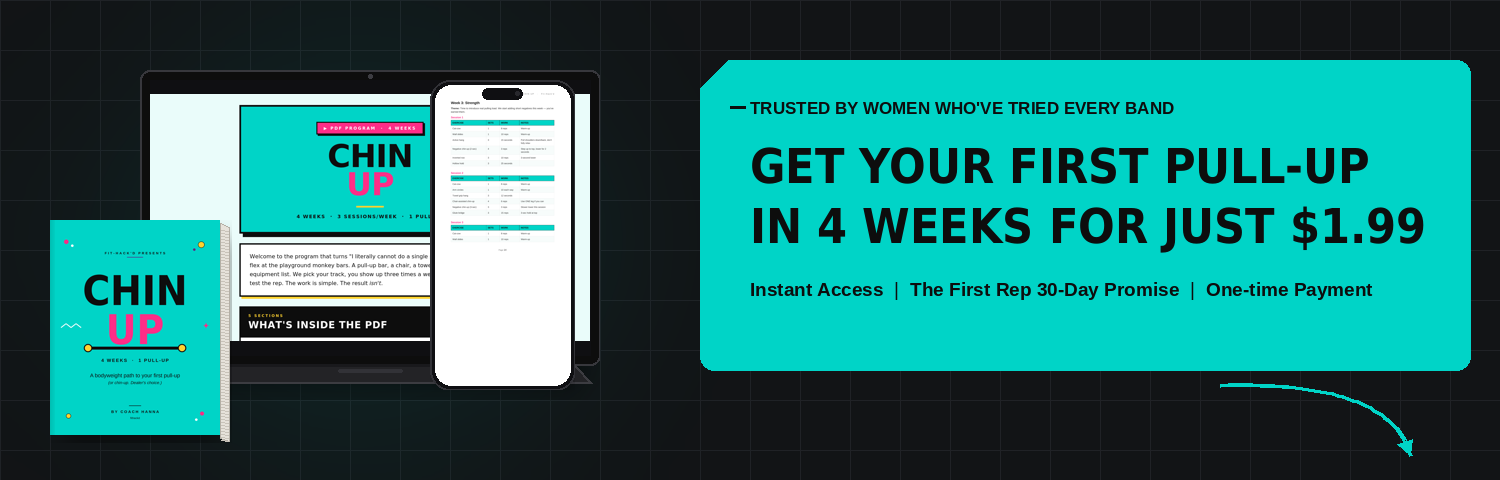
Stop grinding the wrong patterns — get your starting line today and your first unassisted pull-up (or chin-up) in 4 weeks. Even if you can't hold a 10-second hang right now. Even if you've never been close. Even if every program you've tried seems to assume you can already almost do one.
The Real Reason You Can't Do A Pull-Up Has Nothing To Do With strength — It's The Pulling Gap
🔒 Secure Checkout | Instant Access | The "First Rep" 30-Day Promise
As someone who hates confrontation, this playbook was a game-changer. The communication templates helped me handle difficult situations professionally. My only regret is not finding this sooner.
— Jennifer L.
>> get instant access <<
Do Your First Pull-Up Now
Only $1.99 Today
Access InfoSend Book Access
Billing InfoConfirm Details

🔒 100% Secure 256-Bit Encryption

Find Your Starting Line
Follow Your Track
Earn Your First Pull-Up
4 Weeks
There Are Two Types of Women Who've Tried to Do a Pull-Up...
As someone who hates confrontation, this playbook was a game-changer. The communication templates helped me handle difficult situations professionally. My only regret is not finding this sooner.
— Jennifer L.
01
// Most Women Stay Here
Keep Grinding the Band
Those who keep adding sessions, swapping bands, blaming their weight, and quietly wondering if pull-ups are just "not for women like them"...
02
// The Women Who Break Through
Finally See the Pulling Gap
And those who finally discover the problem was never strength — it was a specific, identifiable training gap that no group fitness class, app, or bootcamp ever taught them.
You're clearly not the type who gives up. You're still here, still looking, still willing to try. That tells me everything I need to know about you.
The question isn't whether you're strong enough.
The question is whether you've ever actually been trained for this.
🔒 Secure Checkout | Instant Access | The "First Rep" 30-Day Promise
Trusted By Women Who've Tried Everything Else
As someone who hates confrontation, this playbook was a game-changer. The communication templates helped me handle difficult situations professionally. My only regret is not finding this sooner.
— Jennifer L.

🔒 Secure Checkout | Instant Access | The "Finally Clear" 30-Day Promise
If You're Reading This, You Already Know What It Feels Like To Try Everything and Still Hang There Wondering Why.
✓ You've added "pull-up attempts" to the end of workouts.
✓ You've done band-assisted reps with the thickest band the gym has — and somehow still felt heavy.
✓ You've watched the YouTube videos. Followed the form cues. Practiced negatives in your kitchen.
✓ You've signed up for the 30-day pull-up challenges, paused them at day 6, and felt vaguely guilty about it ever since.
✓ You've walked past the bar at the gym and quietly chosen the lat pulldown machine instead — again.
And somewhere along the way, you started wondering if pull-ups were just... a different kind of strength. The kind some people are built for. The kind you're not.
I want you to know something before we go any further:
It is not a weight problem. It is not a "women aren't designed for pull-ups" problem. That's not a real thing.
But something is happening — something specific, something identifiable, and something completely fixable — and until you know what it is, no amount of band-assisted reps will ever get you to your first strict rep.
🔒 Secure Checkout | Instant Access | The "First Rep" 30-Day Promise
As someone who hates confrontation, this playbook was a game-changer. The communication templates helped me handle difficult situations professionally. My only regret is not finding this sooner.
— Jennifer L.
Right Now, You're Probably...
✗ Doing band-assisted reps with the same band, the same way, week after week — with no measurable transfer to unassisted reps
✗ Hanging from the bar and barely lasting 8 seconds before your grip gives out
✗ Skipping the pull-up bar at the gym because you don't want anyone to see you struggle
✗ Watching other women rep them out casually and assuming they have "different bodies" or "different genetics"
✗ Doing more push-ups, more rows on machines, more lat pulldowns — and wondering why none of it translates
✗ Believing your weight is the issue, even though you've seen heavier women do them and lighter women fail at them
✗ Getting briefly excited about a new pull-up tutorial, trying it for a week, and ending up exactly where you started
✗ Quietly deciding pull-ups are "not your thing" — while still secretly wanting one
And the worst part?
Every time you try harder — more sessions, thicker bands, more reps of the wrong thing — the progress gets smaller and the doubt gets bigger.
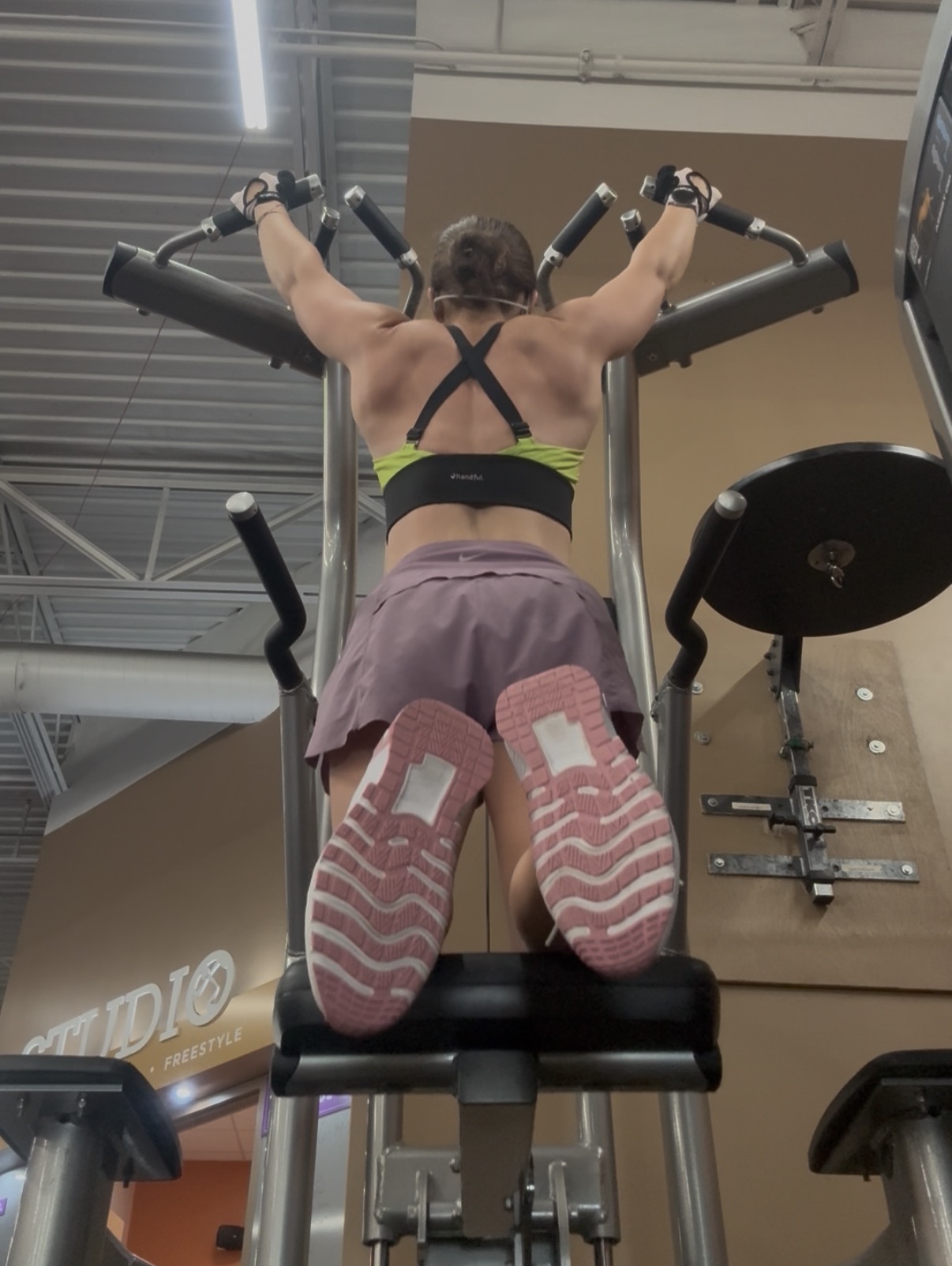
Here's What's Actually Happening — And Why It's Not Your Fault
As someone who hates confrontation, this playbook was a game-changer. The communication templates helped me handle difficult situations professionally. My only regret is not finding this sooner.
— Jennifer L.
01
// Trigger
The Pull-Pattern Drought
Most fitness — group classes, HIIT apps, bootcamps, running — emphasizes pushing patterns, leg work, and cardio. Vertical pulling is rare in most women's training. You've built strength. Just not the strength a pull-up actually requires.
02
// Compound
The Wrong Assistance Trap
When you finally try pull-ups, you go straight to band-assisted reps. The problem: bands give the most help at the bottom of the rep — where it's easiest — and the least help at the top, where you actually need it. You're training a pattern that doesn't transfer.
03
// Result
The Pulling Gap
This is called The Pulling Gap — the dramatic under-development of your back, biceps, and grip pattern relative to your push and leg strength. It's the hidden root cause behind stalled pull-up progress, no matter how many band-assisted reps you've done.
And here's what that's actually costing you:
Every month you spend grinding the same banded reps without addressing The Pulling Gap is another month spent in the wrong pattern. Another month of plateaus. Another month of telling yourself maybe next month.
If you've been "working on pull-ups" for 6+ months, the fix will take weeks. If you've been in it for years, the fix still takes weeks — but the longer you wait, the longer you keep telling yourself a story about your body that isn't true.
The cost of waiting isn't just frustration. It's the version of you who already has the rep.
🔒 Secure Checkout | Instant Access | The "First Rep" 30-Day Promise
You've Probably Already Tried...
✗ Band-assisted pull-ups — which built a banded pull-up, not an unassisted one
✗ Lat pulldown machines — which trained a similar movement, but never the actual vertical pull pattern
✗ "Just doing more push-ups" — which strengthened the wrong direction
✗ Random "30-day pull-up challenges" — which started strong, then stalled because they assumed you could already almost do one
✗ Watching tutorials — which gave you form cues with nowhere to actually apply them
// The Real Reason
These didn't fail because you weren't trying hard enough.
They failed because none of them addressed the The Pulling Gap. They prescribed a pull-up without ever diagnosing where you actually were.
You weren't given a starting line. You were given a finish line and a stopwatch.
And that's exactly what we're going to fix today.
Most women who've never done a pull-up have completed 200+ pushing reps a week — and fewer than 10 pulling reps.
They keep adding more of the same — more push-ups, more lat pulldowns, more banded reps — the exact things widening The Pulling Gap instead of closing it.
They blame their weight when the rep doesn't come.
They tell themselves it's just "not their thing."
And they never get the one thing that would actually change everything:
A real plan built for the gap.
But Here's What's Also True...
FIXABLE.
The Pulling Gap is not permanent. It's not a body type. It's not your genetics.
→ It is a specific, identifiable training pattern deficit.
→ When you know which side of the gap you're on, the path forward becomes clear.
→ The women who break through aren't the ones with "different bodies." They're the ones who stopped grinding banded reps and started training the actual pattern.
And that's exactly what you're about to do.
Here's Why Right Now Is the Most Important Time to Address This
We're living through the most cluttered moment in fitness history.
Every week there's a new pull-up "hack." A new band system. A new influencer telling you the secret is scapular activation or dead hangs or whatever — while selling you another approach that looks just like the ones that already haven't worked.
The fitness industry generates billions of dollars every year by telling everyone the same generic advice regardless of where they actually are.
And the longer you stay in that cycle — trying the next viral video, repping the same band, walking past the bar at the gym — the deeper the story you tell yourself about your own body gets.
0–6 Months In
01
Surface Frustration
Still motivated. Still actively trying. Most generic approaches haven't fully failed yet.
1–2 Years In
02
Quiet Avoidance
You've stopped seriously trying. Pull-ups become "something I don't really do." Other people's reps start to feel like a different sport.
3+ Years In
03
Identity Story
"I'm just not built for pull-ups." "My weight is the problem." "Women like me don't do those." None of these are true. All of them feel true the longer they go uncorrected.
The window to fix this before the story hardens is right now.
✗ Not next Monday. ✗ Not after the holidays. ✗ Not when you "get in better shape first."
Every week you spend in the wrong pattern is another week the gap widens — and another week the story sounds more permanent than it is.
The best time to do this was the first time you couldn't do one in a class.
The second best time is today.
🔒 Secure Checkout | Instant Access | The "First Rep" 30-Day Promise
I Know This Because I Lived It.
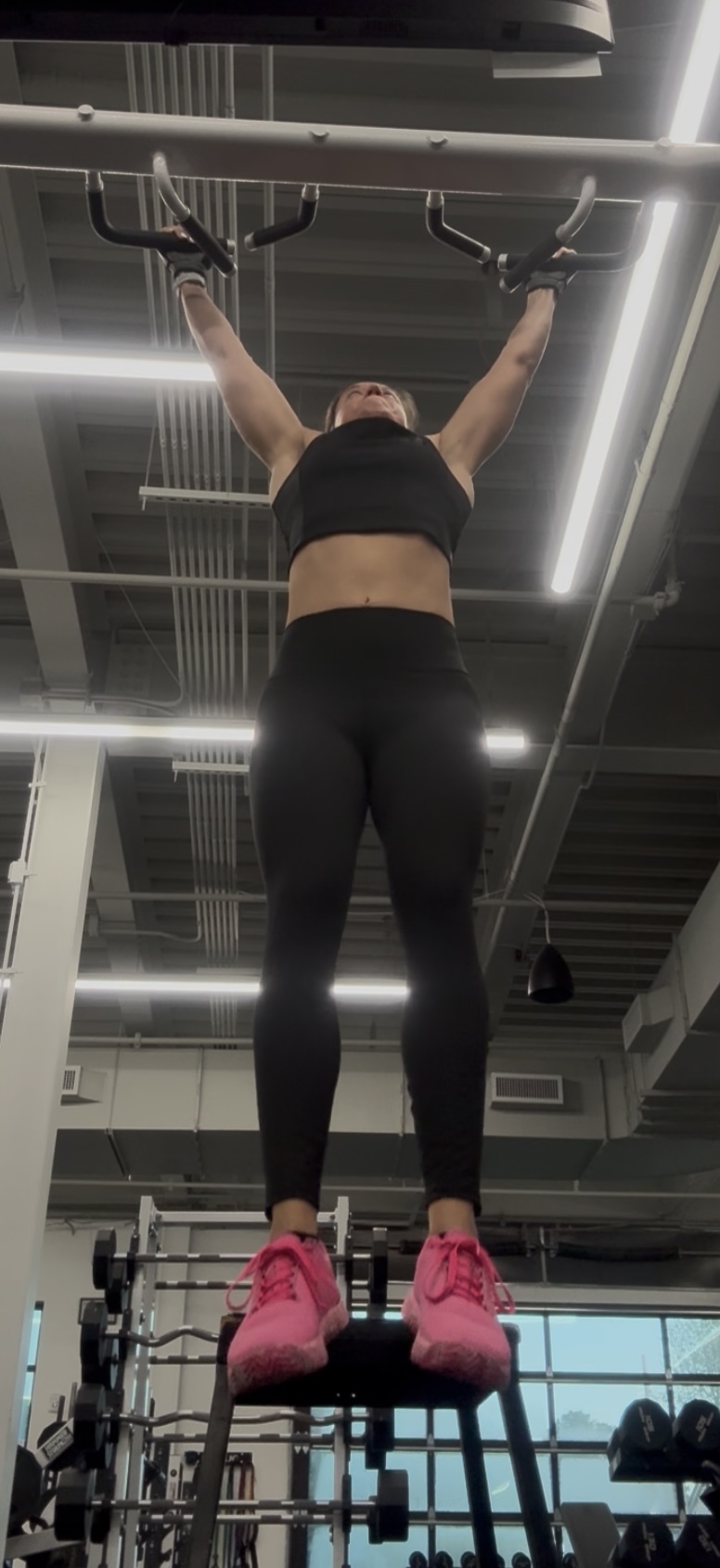
From: Hanna
For years, pull-ups were my white whale.
I'd show up to group fitness class, take my spot at the bar with everyone else, and watch every other person in the room knock out reps like it was nothing. Me? Hanging there. Doing my best "yeah, totally got this" face. Pretending I was just about to start. Reader: I was not just about to start. I could not do one.
And then there were the monkey bars.
I started doing obstacle course racing because I loved the challenge. And every single race — same story. Sprint to the rig. Grab the first bar. Make it two swings. Fall. Do the penalty burpees. Walk away quietly humiliated. Repeat at the next race.
I told myself the same things you've probably told yourself.
"I'm too heavy." I wasn't. "My genetics are bad." They weren't. "I just need to lose a few more pounds and then I'll try again." Spoiler: I never did.
What changed everything wasn't more willpower. It wasn't a stricter diet. It wasn't a thicker band.
It was finally understanding The Pulling Gap.
I stopped pretending more banded reps would fix it. I started training the actual pattern. Real grip work — towel hangs, dead hangs, the boring stuff. Progressive chair-assisted reps that didn't skip the foundation phase. Negatives. Scapular pulls. Inverted rows. The unsexy basics, done consistently, for long enough to actually work.
Then It Finally Clicked.
The first unassisted rep was real. The next one came faster than I expected. Within a few months, I was at three. Then five.
Current PR: 7 strict, unassisted, no-bouncing, no-band pull-ups.
The monkey bars? Officially conquered. I'm the obnoxious one at the playground now.
What I discovered through that process is that closing The Pulling Gap doesn't take more effort. It takes the right effort, in the right order, applied to the right starting line.
The girl who couldn't hold a 10-second hang didn't need to be more disciplined.
She needed someone to tell her where to start.
I built The Chin Up Program so that you never have to guess about that again.
🔒 Secure Checkout | Instant Access | The "First Rep" 30-Day Promise
What Other Women Are Saying
As someone who hates confrontation, this playbook was a game-changer. The communication templates helped me handle difficult situations professionally. My only regret is not finding this sooner.
— Jennifer L.
★★★★★
[TESTIMONIAL PLACEHOLDER —Specific result referencing their adaptation type and what shifted. E.g. "I finally understood why eating more was the answer, not the problem. Finding out I was a Chronic Restrictor changed everything."
Name, Age
Location
★★★★★
[TESTIMONIAL PLACEHOLDER —Specific result referencing the speed and clarity E.g. "I completed this in one sitting and had more direction than I'd had in three years of trying."
Name, Age
Location
★★★★★
[TESTIMONIAL PLACEHOLDER —Specific result referencing the 7-day plan or energy shift. E.g. "By day 5 of the stabilization plan my energy was completely different. I couldn't believe how fast I felt the difference."
Name, Age
Location
🔒 Secure Checkout | Instant Access | The "Finally Clear" 30-Day Promise
The Week 0 Self-Assessment
It Starts With a Starting Line. Not a Workout.
The first step to your first pull-up isn't another set of banded reps. Here's the problem with every pull-up program you've tried before:
They all started at Step 2.
They assumed they knew where you were before they asked a single question about your actual starting point. They handed you a workout designed for a body that was already 80% of the way there — and then wondered why it didn't work for the body that was 20%.
Chin Up starts at Step 1 — with the Week 0 Self-Assessment.
As someone who hates confrontation, this playbook was a game-changer. The communication templates helped me handle difficult situations professionally. My only regret is not finding this sooner.
— Jennifer L.
// Part 1
Find Your Starting Line
Two short tests, about 10 minutes. Test 1: The Dead Hang — how long can you hold a controlled hang from the bar? (Pass: 10+ seconds.) Test 2: The Negative — can you lower yourself from the top of a chin-up with control? (Pass: 3+ seconds.) Most women find out for the first time exactly where they stand.
// PART 2
Place You On The Right Track
Pass both tests, you're on Track B. Pass one or neither, you're on Track A. The work that follows is built around your actual pattern — not a generic template handed to every woman who ever wanted a pull-up.
This is the part that every other program skips.
And it's the reason the women who are already strong get bored and lose motivation in other programs.
🔒 Secure Checkout | Instant Access | The "First Rep" 30-Day Promise
Which One Are You?
01
Track A
Building the Base
You can't yet hold a 10-second controlled hang — OR you can hang but you can't yet lower yourself with control from the top of the bar. Maybe you've tried bands and they didn't seem to transfer. Maybe you've never tried at all. The full rep feels miles away.
The work for you is foundational. Four weeks: Foundation → Volume → Strength → Test Week. We build grip and hang time first (almost always the bottleneck nobody talks about). We layer in the scapular pulls and the chair-assisted variations that train the exact pattern of the full pull-up — no bands, no machines, just you and the bar progressing toward unassisted. By Week 4, you're testing for the real rep.
02
Track B
Bridging the Gap
You can hold a hang for 10+ seconds and lower yourself with at least 3 seconds of control. The pieces are there. You're just not at the top of the rep yet — your "almost" hasn't turned into "got it" yet.
The work for you is targeted. Four weeks: Loading the Pattern → Building the Negative → Approaching the Top → Test Week. We don't waste sessions on movements you've already conquered. Instead, we extend your negatives, tighten your strict pattern, and progressively close the gap at the top of the rep where most women stall. By Week 4, you're testing your first clean, strict, unassisted rep.
The problem isn't you. The problem is that no one has ever shown you which track you should be on — and what to actually do once you're there.
The Chin Up Program changes that — starting with the Week 0 Self-Assessment.
🔒 Secure Checkout | Instant Access | The "First Rep" 30-Day Promise
Introducing:
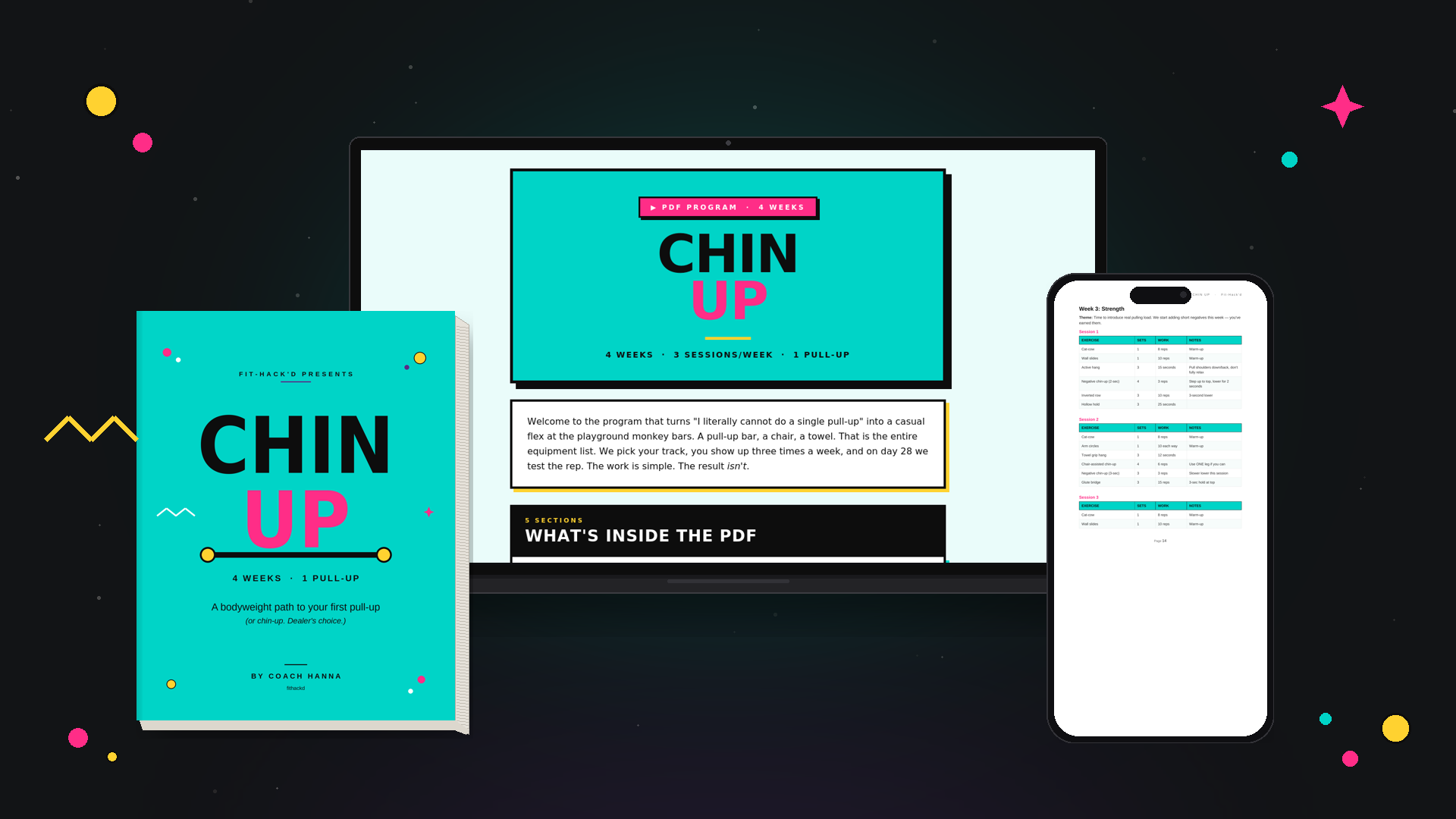
The Chin Up Program
Diagnose your starting line, follow the right track, and earn your first unassisted pull-up (or chin-up) in 4 weeks.
This isn't another 30-day pull-up challenge. It's not a YouTube tutorial. And it's definitely not "just do more banded reps and hope it transfers."
This is a guided 4-week program that starts with a Week 0 Self-Assessment to diagnose your exact starting line, places you on the right track, and walks you through every session — set by set, rep by rep — until your first unassisted rep is real.
Bodyweight-only on purpose. No bands. No machines. No dumbbells. Just you, a bar, a chair, and a towel — because the equipment that gets you to your first rep is the same equipment that built every first rep, ever.
Unlike programs that hand you the workout before they understand your starting point, this one starts with a diagnostic. The work for someone who can't yet hold a 10-second hang is completely different from the work for someone who can already do a controlled negative. And handing both women the same workout is exactly why so many of them are still where they were a year ago.
🔒 Secure Checkout | Instant Access | The "First Rep" 30-Day Promise
Here's Everything Inside:
The 39-Page Chin Up Program PDF
The complete training program. Every workout, every progression, every rep. Delivered as an instant-download PDF you can open on your phone, tablet, or laptop.
✔ The Welcome & Why It Works — What you're actually building, why bodyweight-only beats bands at this stage, and how the program differs from everything you've already tried
✔ Pull-Up vs Chin-Up — Which one you should pick, what the difference actually is, and why you can switch later if you change your mind
✔ How to Use This Program — The schedule, what to do if you miss a day, how to fit it into existing routines, the exact equipment you actually need (almost nothing)
✔ Week 0: The Self-Assessment — Two baseline tests, ten minutes, and the answer to "which track am I on?"
✔ Track A: Building the Base — 4 weeks × 3 sessions a week + an optional Day 4 each week. Foundation → Volume → Strength → Test Week. Every set, rep, and rest written out.
✔ Track B: Bridging the Gap — 4 weeks × 3 sessions a week + an optional Day 4 each week. Loading the Pattern → Building the Negative → Approaching the Top → Test Week. Every variable controlled.
✔ The Exercise Glossary — All 15 movements with form cues, common mistakes, and how to scale up or down. Active hang, dead hang, scap pulls, negatives, chair-assisted reps, towel grip hangs, inverted rows, hollow holds, glute bridges, and every supporting movement
✔ Troubleshooting — The most common things that go sideways and what to do about each
✔ FAQ — Total time commitment, what to do without bar access at home, postpartum guidance, return-from-injury guidance, "do I need cardio?", "what if I don't pass either test?", and what happens after you get the rep
✔ Bonus: 5-Minute Mobility Flow — The pre-session warm-up that protects your shoulders and primes the pull pattern
✔ The Tracker — Weekly tracker pages built into the PDF so you can record every session, every rep, every PR. What gets tracked gets done.
// What This Does
By the end of Week 4, you won't just have a pull-up. You'll have the back, biceps, and grip that earned it — plus a training framework you can run again for more reps.
🔒 Secure Checkout | Instant Access | The "First Rep" 30-Day Promise
More Women Who Finally Got Their Answers
As someone who hates confrontation, this playbook was a game-changer. The communication templates helped me handle difficult situations professionally. My only regret is not finding this sooner.
— Jennifer L.
★★★★★
TESTIMONIAL PLACEHOLDER — Specific result referencing the workbook calculations. E.g. "I had no idea how far below my maintenance calories I'd been eating. Seeing that number was a total wake-up call."
Name, Age
Location
★★★★★
TESTIMONIAL PLACEHOLDER — Specific result referencing the adaptation type quiz. E.g. "The quiz was so accurate it was almost uncomfortable. I was a textbook Weekend Compensator and didn't even realize it."
Name, Age
Location
★★★★★
TESTIMONIAL PLACEHOLDER — Specific result referencing the reset checklist. E.g. "Having everything on one page made it so simple. I stopped overthinking and just followed the checklist."
Name, Age
Location
🔒 Secure Checkout | Instant Access | The "Finally Clear" 30-Day Promise
Here's What This Level of Training Is Actually Worth
To get a personalized pull-up program anywhere else, here's what you'd be looking at:

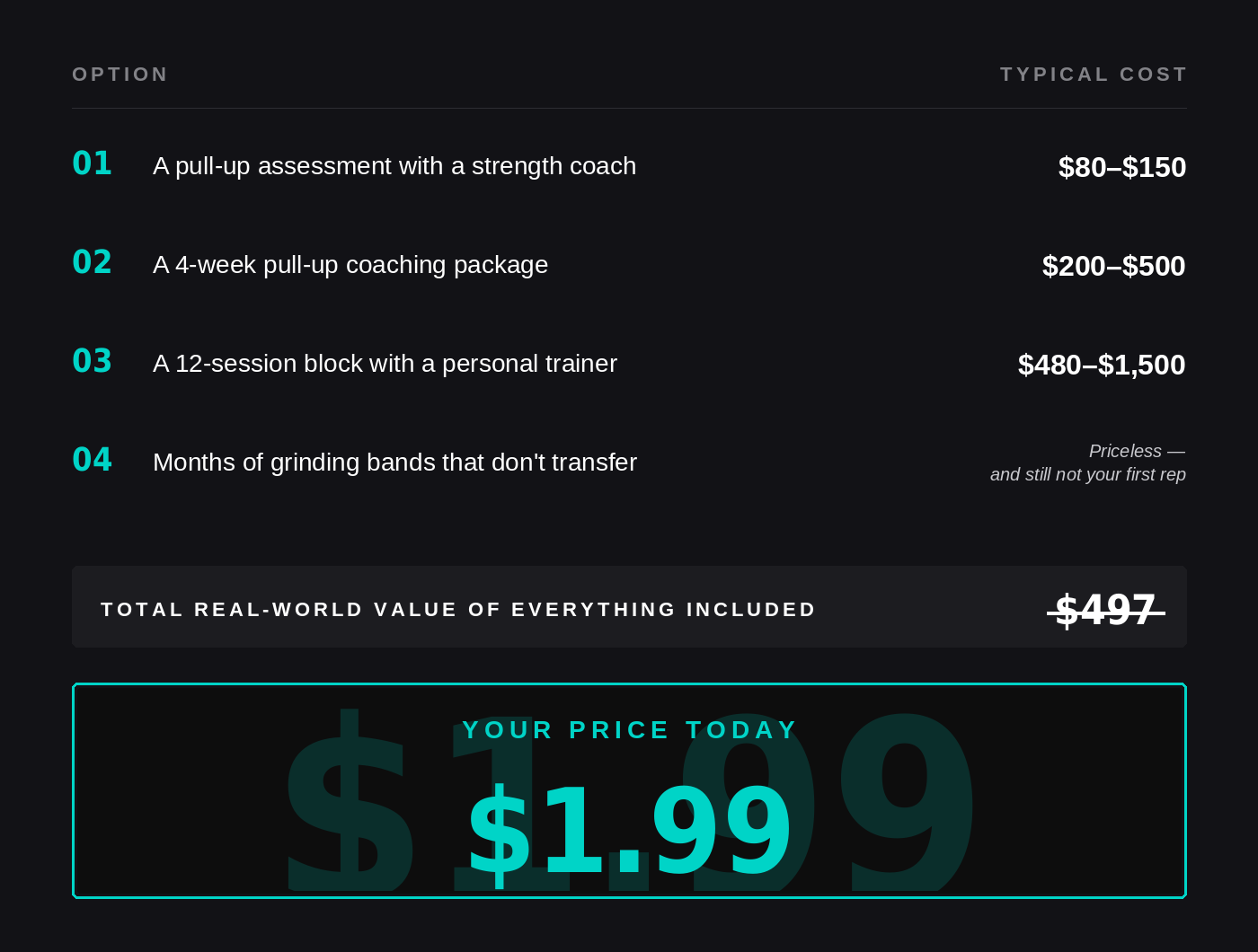
That's less than dinner out. Less than a month of a fitness app that gives every body the same plan. Less than one hour with a trainer who still hasn't asked about your starting line.
And unlike those, this is built around your body — your starting point, your specific gap, your track — not a workout handed to every woman who walked through the door.
🔒 Secure Checkout | Instant Access | The "First Rep" 30-Day Promise
Here's Exactly What Happens When You Click the Button Below:

Step 1:
You'll be taken to our secure checkout page — it takes less than 2 minutes to complete

Step 2:
You'll receive instant access to the complete 39-page program — delivered as a PDF you can open on any device, immediately after purchase

Step 3:
Open the PDF. Read the welcome letter. Get oriented.

Step 4:
Complete the Week 0 Self-Assessment — two short tests, about 10 minutes. You'll know your track by the end.

Step 5:
Schedule your three sessions per week for the next four weeks. (Each session is ~30 minutes, including warm-up.)

Step 6:
Show up. Follow the program. Track every session in the built-in tracker pages.

Step 7:
Week 4 — test for your first rep.
From clicking the button to having the program in your hands: under 2 minutes. From there to your first pull-up: 4 weeks.
🔒 Secure Checkout | Instant Access | The "First Rep" 30-Day Promise
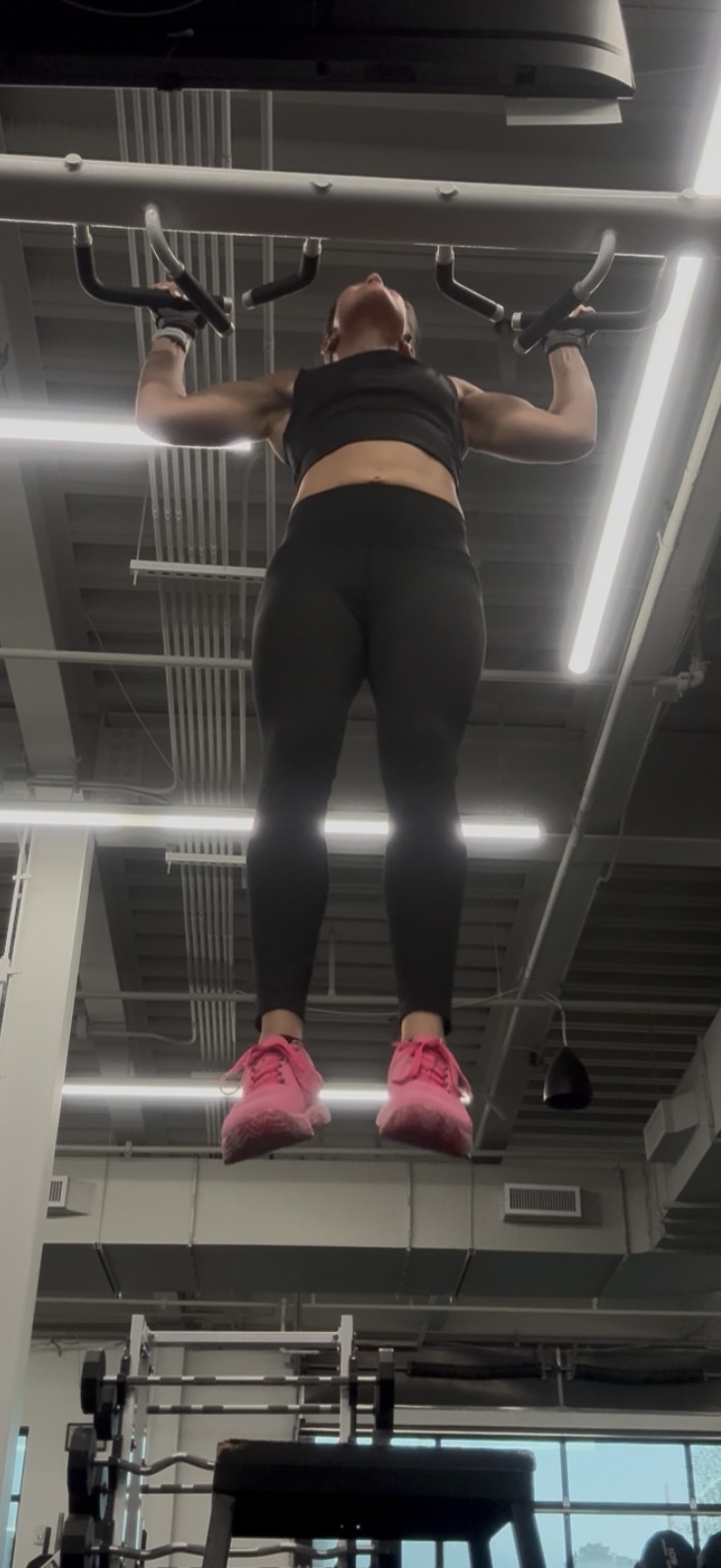
Picture This — 4 weeks From Now
You walk up to a pull-up bar.
→ You don't scan the room first to see who's watching.
→ You don't quietly hope someone's hogging it so you have an excuse to skip it.
→ You don't tell yourself "next time."
Instead, you grip the bar. You engage your back the way you've practiced. You drive your elbows down. Your chin clears the bar.
You let go. You step away. You probably laugh, or swear, or both. You sit down for a second because your hands are shaking, and not from weakness — from the fact that you just did the thing you've been told (and have been telling yourself) was not for you.
The rep is real. It happened. You did it.
You look back at this moment — this page, this decision — as the start of it.
✗ Not because you got smaller.
✗ Not because you found more willpower.
✓ Because you finally got the right starting line.

Six Months From Now, You Could Be Looking Back at Today as the Turning Point.
→ The woman who finally got her first rep — and her second, and her fifth.
→ The woman who stopped flinching at pull-up bars and started walking toward them.
→ The woman who broke the cycle — not by losing weight, not by finding a magic band, but by being trained for the work that actually matters.
It's been doing exactly what you built it to do — push, run, hold, stabilize. It just hasn't been taught to pull.
Now it's time to teach it.
That version of you is 4 weeks away.
The "First rep" 30-Day Promise
Here's my guarantee to you:
Try The Metabolic Peace Protocol for 30 days.
✓ Complete the Week 0 Self-Assessment. ✓ Pick your track. ✓ Do the sessions.
If you do the work and don't see measurable change in your pulling strength — and a real, clear path to your first rep that you didn't have before — simply reach out and I'll refund every penny.
✗ No hoops. ✗ No hassle. ✗ No questions asked.
And here's the part I mean wholeheartedly: you keep the program as my gift to you. Because even if this isn't the right fit, the information inside is too valuable to take back.
You have nothing to lose and everything to gain.
The only risk here is staying on the wrong side of the bar.
🔒 Secure Checkout | Instant Access | The "First Rep" 30-Day Promise
Frequently Asked Questions
Q: How long does this actually take?
A: Four weeks. Three sessions per week (plus an optional Day 4 if you want it). Each session is about 30 minutes, including warm-up. You'll spend ~10 minutes on day one completing the Week 0 Self-Assessment. Total time investment over four weeks: roughly 6–8 hours.
Q: Do I need any special equipment or apps?
A: A pull-up bar (doorway bar works fine, or any sturdy horizontal bar at a park, playground, or gym), a sturdy chair, and a towel. That's the entire equipment list. No bands, no machines, no apps, nothing to download beyond the PDF.
Q: Why no bands?
A: Because bands give you the most help at the bottom of the rep — which is the easiest part anyway — and the least help at the top, which is exactly where most women get stuck. You end up training a pattern that doesn't transfer to an unassisted rep. The program uses chair-assisted reps, dead hangs, scap pulls, and negatives instead — bodyweight progressions that train the exact pattern of the full pull-up.
Q: I've tried a lot of pull-up programs. How is this different?
A: Most programs skip the diagnostic and hand you the workout. They assume you can already do a negative, or hang for 30 seconds, or "almost get one." The Week 0 Self-Assessment starts before that — by identifying exactly where you are. The plan you follow is built for your actual starting line.
Q: What if I can't even hang from the bar for 10 seconds right now?
A: Track A is built for you. The program starts before the hang — with foundational grip work, scapular activation, and pull pattern introduction. You won't be left to "figure out where to start."
Q: What if I can already do a controlled negative?
A: Track B is built for you. The program targets the specific sticking point that's killing your reps — usually the top third — with progressive negatives, strict pattern work, and a deliberately structured approach to closing the gap. You won't waste sessions on movements you've already mastered.
Q: Pull-ups or chin-ups — which should I do?
A: Either counts. Both are real reps. Chin-ups (palms toward you) are often slightly easier for women because they recruit more bicep. Pull-ups (palms away) are slightly harder. The program walks you through choosing — pick the one that motivates you, and you can switch later if you want.
Q: What if I don't have a bar at home?
A: Use a park, playground, or gym. The program needs roughly 30 minutes at the bar per session. If you only have access twice a week instead of three times, the program tells you exactly which sessions to do and how to stretch the program to 6 weeks if needed.
Q: Who is Hanna and why should I trust her?
A: Hanna isn't an elite athlete or a former gymnast. She's someone who couldn't do a single pull-up in group fitness class for years — and who got humiliated on the monkey bars at obstacle course races every single time. What changed wasn't her body. It was finally understanding The Pulling Gap and training for it specifically. Current PR: 7 strict, unassisted pull-ups. Monkey bars: officially conquered. She built this program out of the exact training that worked for her.
Q: What about postpartum, or returning from an injury?
A: The program isn't specifically designed for pregnancy or early postpartum, but if you're cleared for strength training by your provider, the early Track A work (hangs, scap pulls, inverted rows, glute bridges) is gentle and likely fine — the program walks you through what to skip (like hollow holds and dead bugs) until your core is ready. For return-from-injury, check with a PT first, start with Track A regardless of your test results, and skip anything that produces sharp pain.
Q: What if I weigh more than the average person doing pull-ups?
A: Your weight is not the bottleneck. Heavier women do pull-ups. Lighter women fail at them. The Pulling Gap is a programming problem, not a scale problem. The Week 0 Self-Assessment will tell you exactly where you are — independent of what the scale says.
Q: Will I lose weight doing this?What if I've only dieted once or twice?
A: Maybe a little, in your upper back and arms. This is a strength program, not a fat loss program. The big visible change you'll notice is posture — pull-up training tends to clean up upper-body posture quickly.
Q. What happens after I get the rep?
A: You'll have a real, measurable PR — and the strength foundation to build on. The program walks you through what to do if you didn't get there yet (repeat the last two weeks of your track) or if you did (finish the program anyway to turn one rep into multiple). If you want to keep going for more reps, the natural next step is The Iron Era, our 30-day progressive strength program that picks up exactly where Chin Up ends.
🔒 Secure Checkout | Instant Access | The "First Rep" 30-Day Promise
Still on the Fence? Remember...🤔

You're protected by The First Rep 30-Day Promise

You keep the program even if you request a refund

The Week 0 Self-Assessment takes 10 minutes — your first session can happen tomorrow

Your investment is $1.99 — less than a YouTube Premium subscription

Every week you wait is another week telling yourself the same story

The only way you can lose is by not trying
🔒 Secure Checkout | Instant Access | The "First Rep" 30-Day Promise
P.S. — If you're skimming and just landed here at the bottom, here's what you need to know:
You haven't been able to do a pull-up not because you're weak, not because of your weight, not because of "genetics" — but because of a specific, identifiable training pattern deficit called The Pulling Gap. The Chin Up Program starts with a Week 0 Self-Assessment (two short tests, about 10 minutes) to identify exactly where you are right now, place you on the right track (Track A or Track B), and walk you through 12 progressive sessions across 4 weeks until your first unassisted rep is real.
Your investment is $1.99. You're protected by The First Rep 30-Day Promise — and you keep the entire program even if you request a refund.
The only thing between you and your first pull-up is a 10-minute assessment and a decision.
Every week you wait is another week in the wrong pattern. Another week telling yourself a story about your body that isn't true.
Today is the day to stop guessing and start training.
As someone who hates confrontation, this playbook was a game-changer. The communication templates helped me handle difficult situations professionally. My only regret is not finding this sooner.
— Jennifer L.
>> get instant access <<
Do Your First Pull-Up Now
Only $1.99 Today
Access InfoSend Book Access
Billing InfoConfirm Details
🔒 100% Secure 256-Bit Encryption
Copyright © 2026 | Fit-hack'D | All Rights Reserved.
Results vary based on individual implementation. This product is designed to provide education and a personalized framework — not medical advice. Please consult your healthcare provider for any medical concerns.
NOT FACEBOOK™: This site is not a part of the Facebook™ website or Facebook Inc. Additionally, this site is NOT endorsed by Facebook™ in any way. FACEBOOK™ is a trademark of FACEBOOK™, Inc.